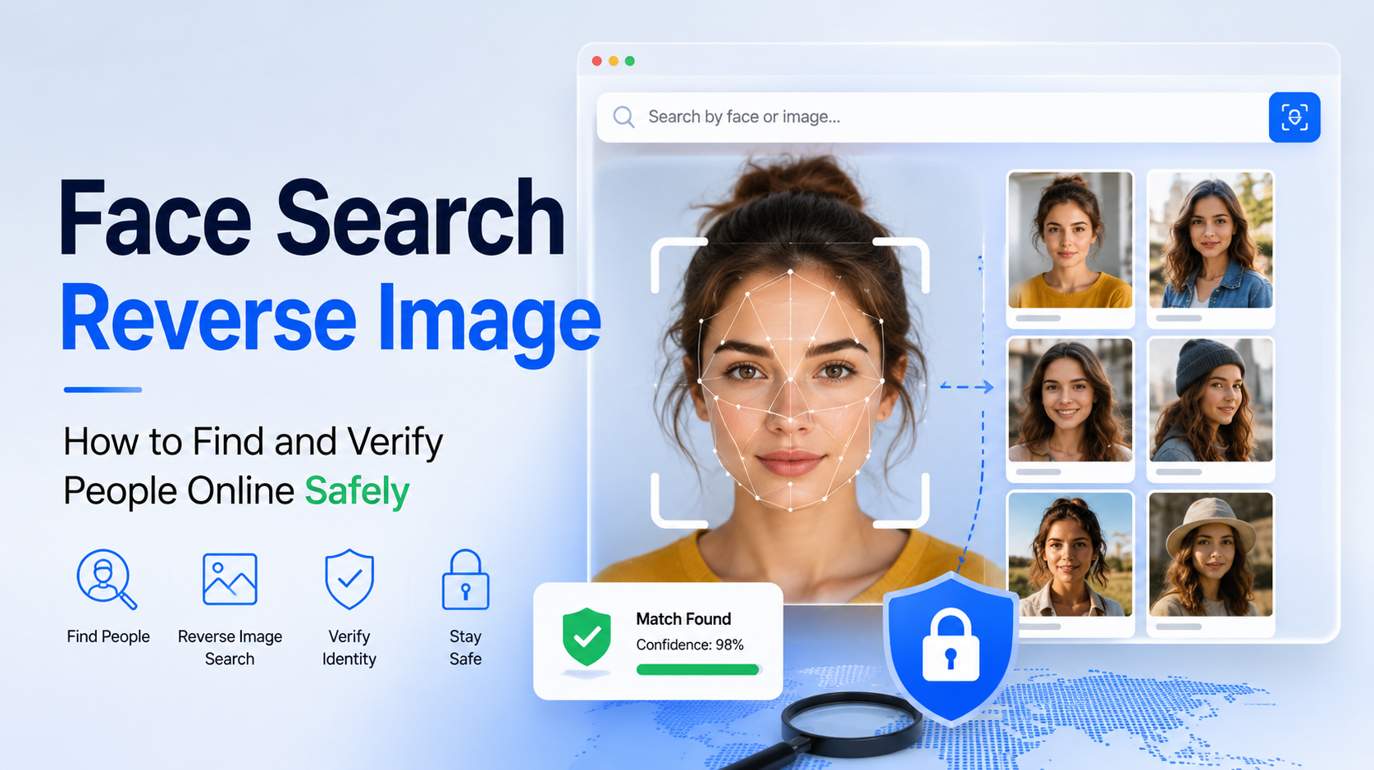
Face Search Reverse Image Dynamics: How to Find and Verify People Online Safely
Imagine a scenario that is becoming increasingly common in the remote-first workforce: a highly qualified candidate applies for an open position at your agency. Their portfolio is spotless, but their LinkedIn headshot looks slightly clinical, or perhaps their communication pattern doesn't quite match the veteran persona on their resume. Alternatively, imagine verifying a source for an investigative journalism piece, or running a routine catfish check on a digital profile that feels too good to be true.
When your primary goal is to verify an identity or identify a person online, general object-recognition tools fall short. You are not searching for the person’s clothing or furniture, your goal is to verify whether the individual in the image truly matches the identity they present online.
Navigating a face reverse image search requires a specialized understanding of biometric engines, jurisdictional privacy walls, and advanced verification tactics.
How Does a Face Search Reverse Image Work?
A reverse image face search engine uses computer vision models to identify a human face within a photo, isolating facial landmarks such as eye spacing, nose width, and jawline structure to build a geometric profile. It then matches this specific vector profile against public online image indexes to locate matching identities across social platforms and web directories.
The Mechanism Behind Reverse Image Search For Identity
When you upload a file into a facial recognition search engine, the algorithm completely ignores the image's file name, metadata, and background pixels. Instead, it treats the human face as a high-dimensional mathematical canvas.
The system maps individual nodes known as facial landmarks. These include:
- The inter-pupillary distance (the exact spacing between the pupils).
- Geometry of the nasal bridge and nose width.
- The curvature and depth of the jawline, chin, and eye sockets.
- The relationship between the upper lip and the base of the nose.
The algorithm translates these spatial coordinates into a unique numerical vector string, a biometric mathematical signature. When executing an image search reverse query, the engine doesn't look for pixel-to-pixel matches. It scans its massive indexed database for matching vector profiles.
This is why advanced engines can successfully find a person by photo even if that individual has aged, changed their hair color, put on glasses, or is smiling in one photo and completely expressionless in another.
Top Platforms Compared for Identity Verification
Because facial data is highly sensitive, the marketplace for executing a reverse face search is deeply fragmented by regional privacy laws.
- Yandex Images (The Practical Giant): As established in our deep-dive Yandex Reverse Image Search guide, Yandex is the most accessible public search engine for facial profiling. Because it does not operate under strict Western regulatory barriers, its facial geometry mapping remains highly aggressive, making it exceptionally proficient at crawling public social networks, blogs, and forum avatars globally.
- Specialist OSINT Engines (PimEyes / FaceCheck.ID): These are hyper-specialized facial recognition search platforms built purely for identification. They do not index web text or product links; they only index faces. They are incredibly powerful but often gate their full URL results behind premium subscription paywalls.
- Google Lens & Bing (The Restricted Gatekeepers): While both platforms have the technical capability to map faces flawlessly, Google and Microsoft have intentionally hobbled their public consumer engines to prevent stalking and privacy liability. If you upload a face, they will cross-reference it against public historical figures, actors, or politicians, but they will deliberately refuse to crawl everyday private citizens.
The Professional’s Checklist for Face Search Reverse Image
To achieve accurate results when you use SnapZain free Reverse Search Image tool for identity validation, the quality of your input photo dictates the success of the output algorithm. Before running your query, apply this preprocessing checklist to optimize your source file:
- Isolate the Face: Crop out distracting backgrounds, secondary individuals, or heavy text elements. For the best accuracy, the person’s face should cover roughly 60% or more of the uploaded image frame.
- Normalize Lighting & Contrast: If the image is heavily shadowed on one side, artificially adjust the shadows and exposure using a native photo editor before uploading. Equalizing the lighting allows the computer vision model to accurately map depth coordinates.
- Neutral Orientation: If the target's head is tilted aggressively, use a rotating tool to straighten the facial plane vertically. Algorithms perform significantly better when the vector layout aligns with a forward-facing grid.
Ethical and Privacy Realities: Managing Your Digital Footprint
Operating a social media reverse image search comes with a profound ethical responsibility. While these utilities are vital for digital self-defense, identifying scammers, and protecting corporate assets, they also illustrate how easily an individual's digital privacy can be compromised.
If you run a search on your own face and discover your likeness is being hosted on an unauthorized site or used to power a fake profile, you have actionable recourse:
- Opt-Out Requests: Major specialized facial recognition engines feature dedicated "Opt-Out" portals where you can upload your picture to permanently block your facial vectors from appearing in public search results.
- DMCA Takedowns: If your copyrighted portrait or headshot is being hosted on an unauthorized site without your permission, issuing a formal DMCA takedown notice forces the web host to legally remove the file.
How Multi-Engine Cross-Referencing Uncovers Hidden Social Media Profiles
Scammers and corporate espionage actors are smart, they rarely use the exact same username or bio across different platforms. However, human vanity means they almost always reuse visual assets across their digital footprint.
To break down single-silo algorithmic blind spots, you must utilize Best Reverse Image Techniques by cross-referencing your targets across multiple index pools.
If a catfish uses a stolen photo that originated on an obscure international platform, a single search on Google won't catch it. But by running a unified reverse image search that dynamically routes your query through regional networks, open web scrapers, and precise duplicate-hash registers.
Conclusion
The capability to verify identities online has evolved from a specialized forensic science into an essential digital-literacy skill. By treating human faces as geometric data webs, modern face search engines allow security professionals, investigators, and everyday internet users to protect themselves against sophisticated fraud and catfish networks.
The trick to using face search reverse image tools effectively lies in recognizing their technical boundaries. Ensure your source images are cleanly edited, respect the privacy implications of the data you handle, and consistently deploy an aggregated multi-engine framework to cross-verify information across independent global networks.
Frequently Asked Questions (FAQs)
Can a Face Reverse Image Search Find Someone if They Have Aged Significantly?
Yes. Advanced biometric computer vision models calculate underlying skeletal structures and relative proportions (such as the distance between bone structures) that remain relatively static throughout adulthood, allowing the system to bridge decades of age progression.
Is It Illegal To Reverse Search Someone's Face Online?
No, it's not legal. Using a public search engine to run an image query is entirely legal. However, the intent and subsequent actions matter legally. Utilizing face search tools to track down individuals for stalking, harassment, or doxxing violates cyber-laws, whereas using them for fraud prevention, recruitment verification, and copyright tracking is perfectly acceptable.
Why Do Specialized Face Search Engines Sometimes Provide Better Results than Google?
Google purposefully limits its public search tools to protect individual privacy and avoid regulatory legal battles. Specialized engines focus exclusively on facial vector algorithms and ignore standard search engine constraints, letting them index global social databases aggressively.
Can These Engines Find Someone Based on a Side-Profile or Silhouette?
Accuracy drops dramatically if the image does not present a clear view of both eyes and the nose bridge. A pure side-profile cuts the geometric data points available to the algorithm in half, making it difficult to generate a reliable biometric signature.
How Can I Remove My Own Face from Public Facial Recognition Databases?
Most dedicated identity-search engines (such as PimEyes and FaceCheck) provide an on-site privacy or opt-out form. You upload a clear photo of yourself, verify your identity, and request that your image vectors be permanently scrubbed or excluded from their public indexing crawls.


